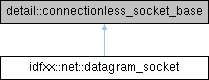
A UDP datagram socket. More...
Classes | |
| struct | config |
| Datagram socket configuration. More... | |
Public Member Functions | |
| datagram_socket () | |
| Creates a new UDP socket with default configuration (IPv4, blocking). | |
| datagram_socket (address_family fam) | |
| Creates a new UDP socket of the given address family. | |
| datagram_socket (const config &cfg) | |
| Creates a new UDP socket with the given configuration. | |
| size_t | send (std::span< const std::byte > buf) |
Sends a datagram on a connected socket (after connect). | |
| result< size_t > | try_send (std::span< const std::byte > buf) |
Sends a datagram on a connected socket (after try_connect). | |
| void | set_broadcast (bool on) noexcept |
| Toggles permission to send datagrams to broadcast addresses. | |
| void | join_multicast_v4 (ipv4_addr group, ipv4_addr interface={}) |
| Joins an IPv4 multicast group so that the socket receives datagrams sent to that group. | |
| result< void > | try_join_multicast_v4 (ipv4_addr group, ipv4_addr interface={}) |
| Joins an IPv4 multicast group so that the socket receives datagrams sent to that group. | |
| void | leave_multicast_v4 (ipv4_addr group, ipv4_addr interface={}) |
| Leaves an IPv4 multicast group. | |
| result< void > | try_leave_multicast_v4 (ipv4_addr group, ipv4_addr interface={}) |
| Leaves an IPv4 multicast group. | |
| void | set_multicast_loopback (bool on) noexcept |
| Toggles whether outgoing multicast packets are also delivered to local sockets that have joined the group. | |
| void | set_multicast_hops (uint8_t hops) noexcept |
| Sets the hop limit (IPv6) / TTL (IPv4) for outgoing multicast packets. | |
| void | set_multicast_interface_v4 (ipv4_addr addr) |
| Selects the local interface used for outgoing IPv4 multicast. | |
| result< void > | try_set_multicast_interface_v4 (ipv4_addr addr) |
| Selects the local interface used for outgoing IPv4 multicast. | |
Static Public Member Functions | |
| static result< datagram_socket > | make () |
| Creates a new UDP socket with default configuration (IPv4, blocking). | |
| static result< datagram_socket > | make (address_family fam) |
| Creates a new UDP socket of the given address family. | |
| static result< datagram_socket > | make (const config &cfg) |
| Creates a new UDP socket with the given configuration. | |
Detailed Description
A UDP datagram socket.
Datagram sockets are connectionless. Use send_to / recv_from for explicit per-message addressing, or call connect() to set a default peer for send / recv.
Neither receive path silently truncates: recv_from reports an oversized datagram via datagram::truncated, while the connected-mode recv(span) returns errc::message_too_long. Either way the datagram is consumed whole, so size the buffer for the largest expected datagram (e.g. 1500 bytes). On a connectionless socket an empty recv span is a received zero-length datagram, never an end-of-stream signal.
Ownership is exclusive: the socket is non-copyable and move-only. A moved-from socket may only be destroyed, move-assigned, or queried via is_open() (→ false) and idf_handle() (→ -1); calling any other method on it is undefined behavior. The destructor closes the socket if open.
Definition at line 60 of file datagram_socket.hpp.
Constructor & Destructor Documentation
◆ datagram_socket() [1/3]
| idfxx::net::datagram_socket::datagram_socket | ( | ) |
Creates a new UDP socket with default configuration (IPv4, blocking).
- Note
- Only available when
CONFIG_COMPILER_CXX_EXCEPTIONSis enabled.
- Exceptions
-
std::system_error on failure.
◆ datagram_socket() [2/3]
|
explicit |
Creates a new UDP socket of the given address family.
- Parameters
-
fam Address family.
- Note
- Only available when
CONFIG_COMPILER_CXX_EXCEPTIONSis enabled.
- Exceptions
-
std::system_error on failure.
◆ datagram_socket() [3/3]
|
explicit |
Creates a new UDP socket with the given configuration.
- Parameters
-
cfg Socket configuration.
- Note
- Only available when
CONFIG_COMPILER_CXX_EXCEPTIONSis enabled.
- Exceptions
-
std::system_error on failure.
Member Function Documentation
◆ join_multicast_v4()
|
inline |
Joins an IPv4 multicast group so that the socket receives datagrams sent to that group.
Equivalent to the POSIX IP_ADD_MEMBERSHIP operation.
- Parameters
-
group Multicast group address to join. interface Local interface address ( {}for default).
- Note
- Only available when
CONFIG_COMPILER_CXX_EXCEPTIONSis enabled.
- Exceptions
-
std::system_error on failure (including errc::wrong_protocol_typeif the socket family is not IPv4).
Definition at line 203 of file datagram_socket.hpp.
◆ leave_multicast_v4()
|
inline |
Leaves an IPv4 multicast group.
Equivalent to the POSIX IP_DROP_MEMBERSHIP operation.
- Parameters
-
group Multicast group address to leave. interface Local interface address ( {}for default).
- Note
- Only available when
CONFIG_COMPILER_CXX_EXCEPTIONSis enabled.
- Exceptions
-
std::system_error on failure.
Definition at line 231 of file datagram_socket.hpp.
◆ make() [1/3]
|
static |
Creates a new UDP socket with default configuration (IPv4, blocking).
- Returns
- The new socket, or an error.
◆ make() [2/3]
|
static |
Creates a new UDP socket of the given address family.
- Parameters
-
fam Address family.
- Returns
- The new socket, or an error.
◆ make() [3/3]
|
static |
Creates a new UDP socket with the given configuration.
- Parameters
-
cfg Socket configuration.
- Returns
- The new socket, or an error.
◆ send()
|
inline |
Sends a datagram on a connected socket (after connect).
- Parameters
-
buf Data to send.
- Note
- Only available when
CONFIG_COMPILER_CXX_EXCEPTIONSis enabled.
- Exceptions
-
std::system_error on failure.
- Returns
- The number of bytes sent — always
buf.size()on success, since a datagram is sent in full or not at all.
Definition at line 167 of file datagram_socket.hpp.
References idfxx::unwrap().
◆ set_broadcast()
|
noexcept |
Toggles permission to send datagrams to broadcast addresses.
Equivalent to the POSIX SO_BROADCAST socket option.
- Parameters
-
on Whether to permit broadcast sends.
◆ set_multicast_hops()
|
noexcept |
Sets the hop limit (IPv6) / TTL (IPv4) for outgoing multicast packets.
Equivalent to the POSIX IPV6_MULTICAST_HOPS / IP_MULTICAST_TTL option (depending on the socket's family).
- Parameters
-
hops Hop limit for multicast packets.
◆ set_multicast_interface_v4()
|
inline |
Selects the local interface used for outgoing IPv4 multicast.
Equivalent to the POSIX IP_MULTICAST_IF option.
The address is not validated against the host's interface list — an address that does not correspond to a local interface is stored and causes subsequent multicast sends to misroute rather than failing here.
- Parameters
-
addr Local interface address.
- Note
- Only available when
CONFIG_COMPILER_CXX_EXCEPTIONSis enabled.
- Exceptions
-
std::system_error with errc::wrong_protocol_typeif the socket family is not IPv4.
Definition at line 281 of file datagram_socket.hpp.
References idfxx::unwrap().
◆ set_multicast_loopback()
|
noexcept |
Toggles whether outgoing multicast packets are also delivered to local sockets that have joined the group.
Equivalent to the POSIX IP_MULTICAST_LOOP / IPV6_MULTICAST_LOOP option (the correct level is chosen automatically based on the socket family).
- Parameters
-
on Whether to enable multicast loopback.
◆ try_join_multicast_v4()
| result< void > idfxx::net::datagram_socket::try_join_multicast_v4 | ( | ipv4_addr | group, |
| ipv4_addr | interface = {} |
||
| ) |
Joins an IPv4 multicast group so that the socket receives datagrams sent to that group.
Equivalent to the POSIX IP_ADD_MEMBERSHIP operation.
- Parameters
-
group Multicast group address to join. interface Local interface address ( {}for default).
- Returns
- Success, or an error code on failure (including
errc::wrong_protocol_typeif the socket family is not IPv4).
◆ try_leave_multicast_v4()
| result< void > idfxx::net::datagram_socket::try_leave_multicast_v4 | ( | ipv4_addr | group, |
| ipv4_addr | interface = {} |
||
| ) |
Leaves an IPv4 multicast group.
Equivalent to the POSIX IP_DROP_MEMBERSHIP operation.
- Parameters
-
group Multicast group address to leave. interface Local interface address ( {}for default).
- Returns
- Success, or an error code on failure.
◆ try_send()
| result< size_t > idfxx::net::datagram_socket::try_send | ( | std::span< const std::byte > | buf | ) |
Sends a datagram on a connected socket (after try_connect).
- Parameters
-
buf Data to send.
- Returns
- The number of bytes sent — always
buf.size()on success, since a datagram is sent in full or not at all — or an error.
◆ try_set_multicast_interface_v4()
Selects the local interface used for outgoing IPv4 multicast.
Equivalent to the POSIX IP_MULTICAST_IF option.
The address is not validated against the host's interface list — an address that does not correspond to a local interface is stored and causes subsequent multicast sends to misroute rather than failing here.
- Parameters
-
addr Local interface address.
- Return values
-
errc::wrong_protocol_type the socket family is not IPv4
The documentation for this class was generated from the following file:
- idfxx_net/include/idfxx/net/datagram_socket.hpp